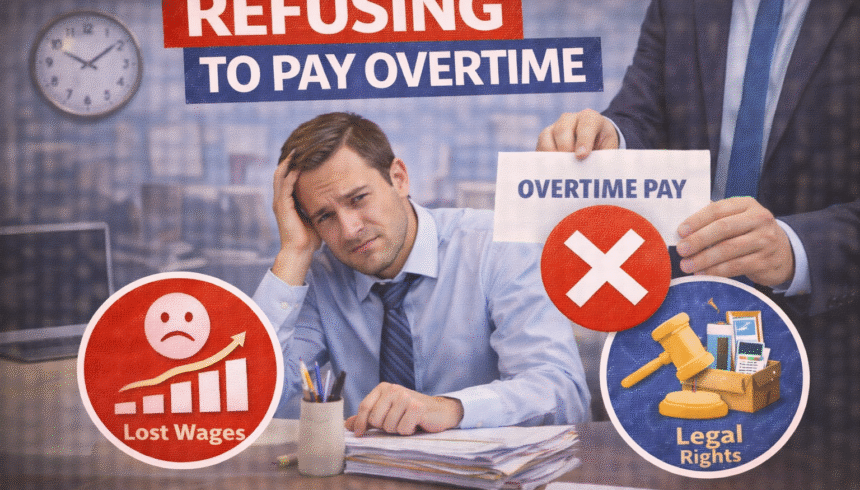
Can Your Employer Refuse to Pay for Unauthorized Overtime?
February 19, 2026
  • Evan Lange By Evan Lange
  • No comment

Before proceeding, please review the  legal disclaimer.

Can Your Employer Refuse to Pay for Unauthorized Overtime?

You stayed late.
You finished the project.
You worked more than 40 hours.

But now your employer says:
“Overtime wasn’t approved, so we’re not paying for it.”

Is that legal?

In Texas—and under federal law—the short answer is: usually no. Employers generally must pay for overtime hours worked, even if those hours were not pre-approved. However, there are important details that matter.

Let’s break it down clearly.


What Counts as Overtime?

Under federal law (the Fair Labor Standards Act or FLSA), most non-exempt employees must receive:

  • Time and a half for hours worked over 40 in a workweek.

That means if you are hourly and not exempt from overtime laws, working 41+ hours in a week typically triggers overtime pay.

Texas follows federal overtime rules for most private employers.


Does Overtime Have to Be Approved to Be Paid?

Here’s the key point:

If your employer knew or should have known you were working overtime, they are generally required to pay you for it—even if it wasn’t authorized in advance.

An employer cannot accept the benefit of your work and then refuse to pay for it.


What Employers Can Do

While employers usually must pay for overtime worked, they can:

  • Require advance approval for overtime

  • Discipline employees for violating overtime policies

  • Enforce scheduling rules

So your employer might be allowed to discipline you for working unauthorized overtime—but they typically cannot refuse to pay you for hours actually worked.

That’s an important distinction.


What Employers Cannot Do

In most cases, an employer cannot:

  • Refuse to pay for overtime that was worked

  • “Erase” hours from a timecard

  • Tell you to clock out and keep working

  • Average hours across multiple weeks

  • Replace overtime pay with comp time (in most private-sector jobs)

If you worked the hours, you are generally entitled to compensation.


What If You Worked “Off the Clock”?

Off-the-clock work is one of the most common overtime violations.

Examples include:

  • Answering emails after hours

  • Finishing tasks after clocking out

  • Working through lunch without pay

  • Arriving early to set up

If management knows this is happening—or encourages it—it may still qualify as payable overtime.


What Does “Knew or Should Have Known” Mean?

This phrase is critical.

Employers are responsible for paying overtime if:

  • A supervisor saw you working late

  • Work was assigned that required overtime

  • Emails show you were working after hours

  • The workload made overtime unavoidable

Employers cannot ignore obvious overtime work and then claim ignorance.


Are There Exceptions?

Yes. Not all employees qualify for overtime.

Some employees are classified as “exempt,” including certain:

  • Executives

  • Administrators

  • Professionals

  • Outside sales employees

If you are properly classified as exempt, overtime rules may not apply.

However, misclassification is common—and sometimes intentional.


What If Your Employer Refuses to Pay?

If an employer refuses to pay for unauthorized overtime, employees may consider:

  • Reviewing their job classification

  • Gathering time records

  • Saving emails or communications

  • Documenting schedules and assignments

Overtime disputes often depend on detailed evidence.


Can You Be Fired for Reporting Unpaid Overtime?

Retaliation for asserting wage rights is generally illegal.

Employers typically cannot:

  • Fire you

  • Demote you

  • Reduce your hours

  • Harass you

because you raised concerns about unpaid wages.

If negative action follows a wage complaint, retaliation may be an issue.


Common Employer Arguments

Employers sometimes argue:

  • “You didn’t get approval.”

  • “You volunteered to work extra.”

  • “You didn’t report the time properly.”

But if the employer allowed or benefited from the work, those arguments may not eliminate the obligation to pay.


Final Takeaway

In most cases, your employer cannot refuse to pay you simply because overtime was not authorized.

They may discipline you for violating policy—but if you worked the hours and they knew (or should have known), the law generally requires payment.

The difference between policy violations and wage violations matters. And if overtime goes unpaid, it may not just be unfair—it could be unlawful.


Leave a Reply

Your email address will not be published. Required fields are marked *

    Contact us for a consultation

    *Please do not include any confidential or sensitive information in this form. This form sends information by non-encrypted e-mail which is not se.Submitting this form does not create an attorney-client relationship. Once I have read your submission, I may contact you for more information or to arrange for a consultation with you.

    Mr. Evan B. Lange is the attorney responsible for this website. | All meetings are by appointment only. | Principal place of business: Sugar Land and Houston, Texas.
    The information you obtain at this site is not, nor is it intended to be, legal advice. You should consult an attorney for advice regarding your individual situation. We invite you to contact us and welcome you to submit your claim for review. Contacting us does not create an attorney-client relationship. Please do not send any confidential information to us until such time as an attorney-client relationship has been established.