Before proceeding, please review the legal disclaimer.
When most people think about discrimination, they picture one person making a biased comment or a manager intentionally treating someone unfairly.
But discrimination is not always obvious or personal.
Sometimes it’s built into policies, practices, or workplace culture. That’s known as systemic discrimination—and it can affect entire groups of employees without a single openly discriminatory statement ever being made.
Understanding systemic discrimination is important because it often hides in plain sight.
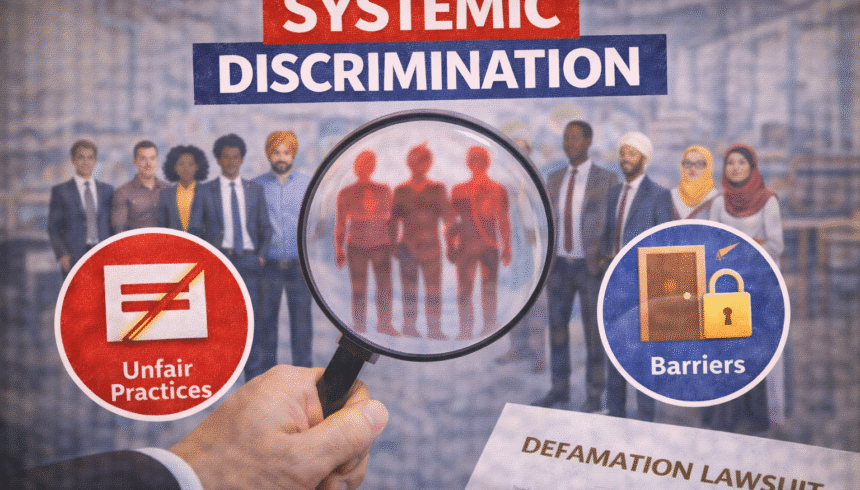
Systemic discrimination (sometimes called structural or institutional discrimination) occurs when workplace policies, procedures, or patterns disproportionately harm a protected group—even if no one openly intends to discriminate.
Instead of targeting one individual, systemic discrimination affects multiple employees in similar ways.
It often shows up as:
Patterns of unequal promotion
Unequal pay across demographic groups
Hiring pipelines that exclude certain communities
Disciplinary systems that impact one group more harshly
The issue isn’t always a single decision—it’s the pattern.
Individual discrimination typically involves:
A direct biased comment
A specific unfair decision
Targeted treatment toward one employee
Systemic discrimination involves:
Company-wide policies
Repeated patterns
Statistical disparities
Long-term inequality
It’s less about one bad actor and more about how the system operates.
Here are common workplace examples:
A company recruits only from certain schools that lack diversity, limiting opportunities for qualified candidates from other backgrounds.
Year after year, management positions are filled almost exclusively by one demographic group despite a diverse workforce.
Employees performing the same job receive different pay rates across gender or racial lines.
One group of employees receives harsher discipline for similar conduct compared to others.
Desirable shifts or high-earning assignments consistently go to one group of workers.
Individually, these actions may appear neutral. Collectively, they can reveal systemic bias.
Not always.
Under employment law, discrimination does not always require proof of intentional bias. In some cases, a policy that appears neutral can still be unlawful if it disproportionately harms a protected group and is not justified by business necessity.
This concept is often referred to as disparate impact.
For example:
A physical test unrelated to actual job duties that excludes certain applicants.
A blanket policy that screens out candidates with minor criminal records without evaluating relevance.
If the policy is not job-related and consistent with business necessity, it may be challenged.
Systemic discrimination cases often rely on:
Statistical evidence
Internal employment data
Pay comparisons
Promotion history
Policy analysis
Testimony from multiple employees
Unlike individual claims, these cases often involve broader investigations.
Systemic discrimination can be difficult to recognize because:
There may be no offensive comments
Policies appear neutral on paper
Decisions are spread across departments
Disparities develop gradually over time
Employees often notice something feels unfair long before they can identify a clear legal issue.
If you suspect systemic discrimination, consider:
Observing patterns in hiring, pay, or promotions
Documenting disparities
Reviewing company policies
Speaking with other affected employees
Seeking guidance before filing complaints
These cases are often complex and require careful evaluation.
One of the risks in raising systemic concerns is retaliation. Employers cannot legally punish employees for:
Reporting discrimination
Participating in investigations
Raising concerns about workplace inequality
Retaliation itself can be a separate legal violation.
Systemic discrimination affects more than one person—it shapes workplace culture, career growth, and income over time.
Recognizing the difference between isolated unfair treatment and broader patterns is key to understanding whether legal protections may apply.
Systemic discrimination occurs when workplace policies or patterns disproportionately harm protected groups—even without obvious intent.
It’s not always loud or visible. Often, it’s revealed through patterns over time.
Understanding how systemic discrimination works empowers employees to identify whether what they’re experiencing is just workplace frustration—or something more serious under the law.
Follow our newsletter to stay updated.
2025- The Lange Firm all rights reserved.
Mr. Evan B. Lange is the attorney responsible for this website. | All meetings are by appointment only. | Principal place of business: Sugar Land and Houston, Texas.
The information you obtain at this site is not, nor is it intended to be, legal advice. You should consult an attorney for advice regarding your individual situation. We invite you to contact us and welcome you to submit your claim for review. Contacting us does not create an attorney-client relationship. Please do not send any confidential information to us until such time as an attorney-client relationship has been established.