Before proceeding, please review the legal disclaimer.
Getting injured at work can create a lot of uncertainty.
You may be wondering:
One of the most common questions injured employees ask is:
👉 Can you be on FMLA while receiving workers’ compensation benefits?
In many cases, the answer is:
👉 Yes.
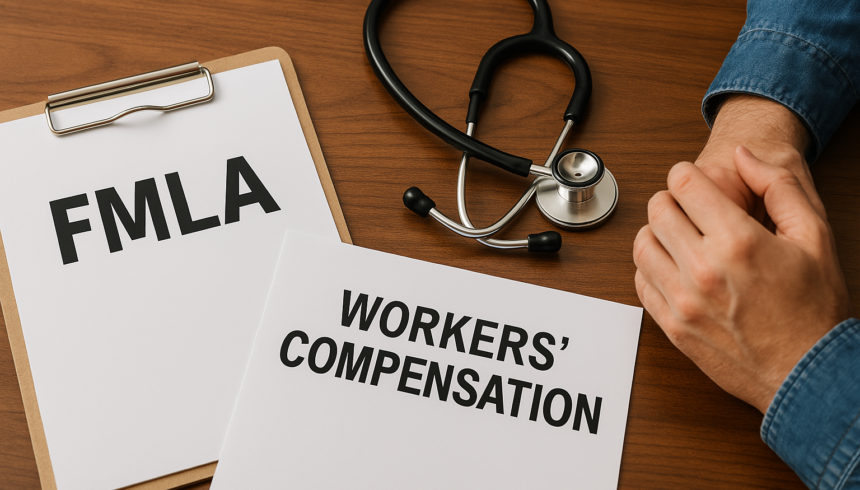
Workers’ compensation and the Family and Medical Leave Act (FMLA) are different laws that serve different purposes, and sometimes they can run at the same time.
Understanding how these laws interact is important for Texas employees recovering from workplace injuries.
Often:
👉 Yes.
An employer may designate leave as FMLA leave while an employee is out because of a work-related injury.
This means:
The two programs are not mutually exclusive.
In fact, employers often run them concurrently when both laws apply.
Workers’ compensation is a system designed to provide benefits to employees who suffer work-related injuries or illnesses.
Depending on the situation, benefits may include:
Workers’ compensation focuses on:
👉 Workplace injuries and illnesses.
The Family and Medical Leave Act (FMLA) is a federal law that allows eligible employees to take protected leave for certain qualifying reasons.
Eligible employees may receive up to:
👉 12 weeks of unpaid, job-protected leave
during a 12-month period.
FMLA focuses on:
👉 Job protection.
Unlike workers’ compensation, FMLA does not generally provide wage replacement benefits.
Because each law addresses a different issue.
Workers’ compensation provides:
FMLA provides:
When a workplace injury qualifies as a serious health condition under the FMLA, employers often designate the absence under both programs.
To qualify for FMLA, the injury generally must meet the definition of a:
👉 Serious health condition.
Examples may include:
Many workplace injuries satisfy this requirement.
In many situations:
👉 Yes.
Employers may require FMLA leave and workers’ compensation leave to run at the same time if:
This prevents employees from stacking separate periods of leave one after another.
Not necessarily.
This is one of the biggest misconceptions employees have.
Workers’ compensation primarily provides:
It does not automatically guarantee indefinite job protection.
That is one reason FMLA can be so important.
This is where many employees encounter problems.
Once FMLA leave is exhausted:
👉 Additional legal protections may or may not apply.
Possible considerations include:
Every situation is different.
Sometimes.
Receiving workers’ compensation benefits does not automatically prevent termination.
However:
👉 Employers generally cannot retaliate against employees simply for pursuing workers’ compensation benefits.
The reason for the termination matters.
Workers’ compensation retaliation may occur when an employer takes adverse action because an employee:
Potential examples include:
The timing and facts often become critical.
Many employees face this situation.
The next question often becomes:
👉 Is additional leave or accommodation required?
This may involve the Americans with Disabilities Act (ADA).
Depending on the circumstances, employers may need to evaluate:
The analysis depends on the employee’s medical condition and job requirements.
Potentially.
Workers’ compensation and light-duty assignments can create complicated issues.
The answer may depend on:
Employees should carefully evaluate their options before refusing offered work.
Under the FMLA, employers generally must maintain group health insurance coverage during protected leave under the same conditions that would have applied if the employee had continued working.
This protection can be extremely important during recovery.
If you are dealing with both workers’ compensation and FMLA, maintain copies of:
Documentation often becomes critical if disputes arise.
Workers’ compensation benefits and job protection are not the same thing.
Failure to complete required forms can create problems later.
Treatment records often become important evidence.
FMLA leave is generally limited to 12 weeks in most situations.
No.
Workers’ compensation provides injury-related benefits.
FMLA provides protected leave.
Not necessarily.
The two leaves often run concurrently.
Not always.
The reason for the termination matters.
Not necessarily.
Other protections such as the ADA may still apply.
According to the U.S. Department of Labor, millions of employees rely on FMLA protections each year to manage serious medical conditions and recovery periods. (U.S. Department of Labor, 2025)
At the same time, workplace injuries continue to affect workers across virtually every industry.
Understanding how these laws work together can help employees:
At The Lange Firm, we help Texas employees evaluate workplace issues involving:
Because recovering from a workplace injury is difficult enough without also worrying about your job and legal rights.
Yes. Employers often designate leave under both programs simultaneously when a workplace injury qualifies as a serious health condition.
Not necessarily. Workers’ compensation primarily provides medical and income benefits. FMLA and other laws may provide job-protection rights.
Sometimes. However, employers generally cannot retaliate against employees for filing or pursuing workers’ compensation claims.
Additional protections may depend on the circumstances and could involve disability accommodation laws such as the ADA.
Yes. Medical records, leave notices, doctor restrictions, and employer communications can become important if disputes arise.
Workers’ compensation and FMLA are separate laws, but they often work together when employees suffer workplace injuries.
Understanding the difference is critical.
Workers’ compensation may provide:
While FMLA may provide:
Knowing how these programs interact can help employees better protect their rights during recovery.
Suggested Meta Description:
Can you take FMLA while receiving workers’ compensation in Texas? Learn how these laws work together, job protections, and employee rights in 2026.
FAQ Schema-Ready Q&A Pairs
Q: Can FMLA and workers’ compensation run at the same time?
A: Yes. Employers often designate leave under both programs simultaneously when a workplace injury qualifies as a serious health condition.
Q: Does workers’ compensation protect my job?
A: Not necessarily. Workers’ compensation primarily provides medical and income benefits, while FMLA may provide job protection.
Q: Can I be fired while receiving workers’ compensation benefits?
A: Sometimes. However, employers generally cannot retaliate against employees for filing or pursuing workers’ compensation claims.
Q: What happens when my FMLA leave ends?
A: Additional protections may depend on the circumstances and could involve disability accommodation laws such as the ADA.
Q: Should I keep copies of FMLA and workers’ compensation paperwork?
A: Yes. Medical records, leave notices, doctor restrictions, and employer communications can become important if disputes arise.
Follow our newsletter to stay updated.
2025- The Lange Firm all rights reserved.
Mr. Evan B. Lange is the attorney responsible for this website. | All meetings are by appointment only. | Principal place of business: Sugar Land and Houston, Texas.
The information you obtain at this site is not, nor is it intended to be, legal advice. You should consult an attorney for advice regarding your individual situation. We invite you to contact us and welcome you to submit your claim for review. Contacting us does not create an attorney-client relationship. Please do not send any confidential information to us until such time as an attorney-client relationship has been established.