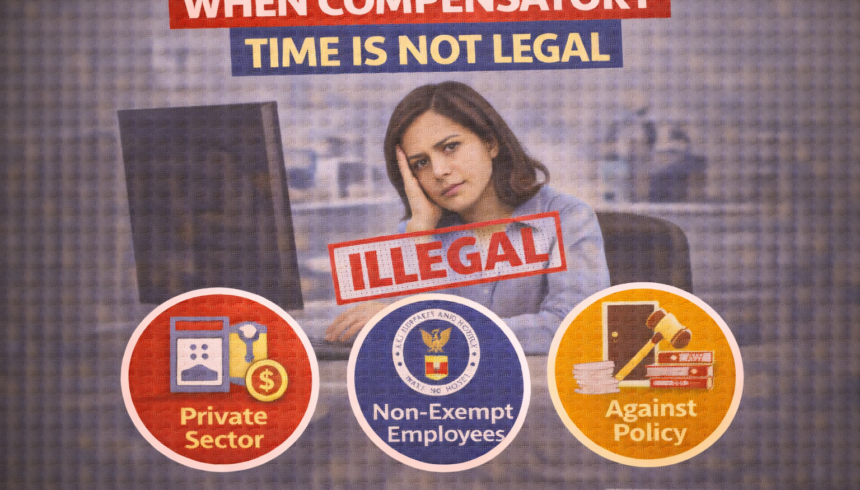
When Compensatory Time Is Not Legal
March 10, 2026
  • Evan Lange By Evan Lange
  • No comment

Before proceeding, please review the  legal disclaimer.

When Compensatory Time Is Not Legal

Many employees have heard the term “comp time” or compensatory time. Employers sometimes offer it as an alternative to paying overtime wages. Instead of paying time-and-a-half for overtime hours worked, the employer gives the employee time off later.

At first glance, this may seem fair. But under federal wage laws, compensatory time is often illegal in private-sector workplaces.

Understanding when comp time is not allowed can help employees recognize wage violations and help employers avoid costly legal mistakes.


What Is Compensatory Time?

Compensatory time—commonly called comp time—is time off given to an employee instead of overtime pay.

For example:

  • An employee works 10 extra hours one week.

  • Instead of paying overtime, the employer allows the employee to take time off later.

While this arrangement may sound convenient, the legality depends on who the employer is and how the time is handled.


What Federal Law Says About Overtime

The Fair Labor Standards Act (FLSA) governs minimum wage and overtime requirements in the United States.

Under the FLSA, most non-exempt employees must receive:

  • Time-and-a-half pay for any hours worked over 40 hours in a workweek.

This requirement applies to most private employers.

Because of this rule, many comp time arrangements violate federal wage law.


When Comp Time Is Not Legal

Comp time is generally not legal for private-sector employers when it replaces overtime pay.

If an employee works more than 40 hours in a workweek, the employer typically must pay overtime wages—not future time off.

Examples of illegal comp time practices include:

  • Offering time off later instead of paying overtime

  • Allowing employees to “bank” overtime hours for future days off

  • Averaging work hours across multiple weeks to avoid overtime pay

  • Giving straight time off instead of time-and-a-half pay

In most private workplaces, these arrangements violate federal wage laws.


When Comp Time May Be Allowed

Compensatory time may be legal in government jobs.

Public-sector employers—such as state or local governments—are allowed to offer comp time instead of overtime pay under certain conditions.

However, strict rules apply. For example:

  • Comp time must generally accrue at time-and-a-half rates

  • There are limits on how much comp time can be accumulated

  • Employees must agree to the arrangement

  • The time must eventually be used or paid out

These rules apply primarily to public employees, not private companies.


Common Misconceptions About Comp Time

Many employees assume comp time is normal because some workplaces have long used the practice.

However, common misconceptions include:

  • “If employees agree to it, comp time is legal.”

  • “Small businesses don’t have to follow overtime rules.”

  • “We can average hours across two weeks.”

  • “Salary employees never qualify for overtime.”

In reality, federal wage laws apply broadly, and voluntary agreements do not override overtime requirements.


Comp Time vs. Flexible Scheduling

Comp time is different from flexible scheduling.

For example:

If an employee works extra hours early in the week but leaves early later in the same workweek—without exceeding 40 hours total—this may be allowed.

But once the employee exceeds 40 hours in a workweek, overtime pay requirements typically apply.

Employers cannot shift hours into the next week to avoid overtime obligations.


Industries Where Comp Time Violations Are Common

Illegal comp time practices frequently appear in industries such as:

  • Restaurants and hospitality

  • Retail

  • Construction

  • Healthcare

  • Transportation

  • Small businesses

These industries often have fluctuating schedules and overtime demands.


What Employees Should Watch For

Employees may want to pay attention if their employer:

  • Offers time off instead of overtime pay

  • Tells them to “bank” overtime hours

  • Changes timecards to avoid overtime

  • Requires off-the-clock work

  • Refuses to pay overtime when hours exceed 40

These practices may indicate wage law violations.


Consequences for Employers

Employers who violate overtime laws may face significant penalties, including:

  • Back pay for unpaid overtime

  • Liquidated damages (often double the unpaid wages)

  • Attorney’s fees and legal costs

  • Government fines or penalties

If multiple employees are affected, wage claims can grow quickly.


Final Takeaway

Compensatory time may sound like a fair alternative to overtime pay, but in most private workplaces it is not legal.

Under federal wage laws, non-exempt employees who work more than 40 hours in a workweek must generally receive overtime pay, not future time off.

Understanding the difference between lawful scheduling flexibility and illegal comp time helps ensure that both employees and employers stay compliant with wage laws.


Leave a Reply

Your email address will not be published. Required fields are marked *

    Contact us for a consultation

    *Please do not include any confidential or sensitive information in this form. This form sends information by non-encrypted e-mail which is not se.Submitting this form does not create an attorney-client relationship. Once I have read your submission, I may contact you for more information or to arrange for a consultation with you.

    Mr. Evan B. Lange is the attorney responsible for this website. | All meetings are by appointment only. | Principal place of business: Sugar Land and Houston, Texas.
    The information you obtain at this site is not, nor is it intended to be, legal advice. You should consult an attorney for advice regarding your individual situation. We invite you to contact us and welcome you to submit your claim for review. Contacting us does not create an attorney-client relationship. Please do not send any confidential information to us until such time as an attorney-client relationship has been established.