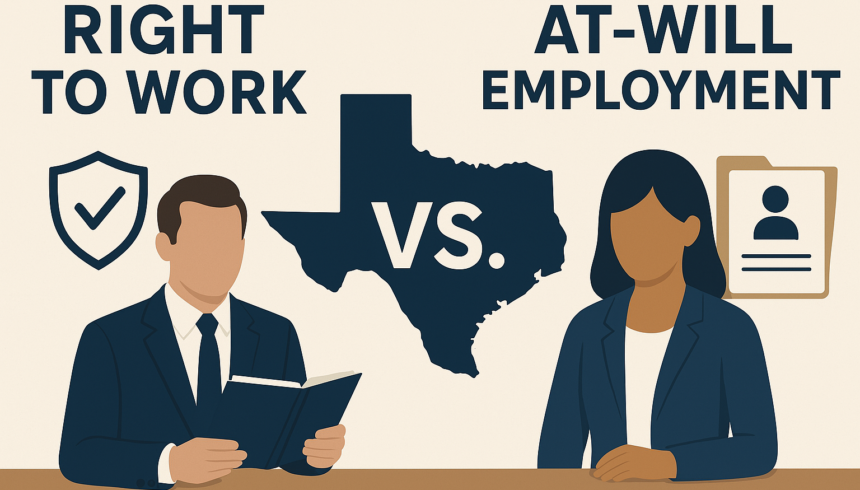
Right to Work vs At Will Employment in Texas: What’s the Difference?
April 14, 2025
  • The Lange Firm By The Lange Firm
  • No comment

Before proceeding, please review the  legal disclaimer.

Right-to-Work vs. At-Will Employment in Texas (2026 Guide): What’s the Difference?

Many Texas employees hear terms like:

  • “Right-to-work”
  • “At-will employment”

and assume they mean the same thing.

They do not.

In fact, these are two completely different legal concepts.

Unfortunately, confusion about these terms often leads employees to misunderstand their workplace rights.

One of the most common questions employment lawyers hear is:

👉 What is the difference between right-to-work and at-will employment in Texas?

The short answer is:

👉 Right-to-work deals with union membership.

👉 At-will employment deals with termination.

Understanding the distinction is important because these laws affect employees in very different ways.


What Is Right-to-Work?

Texas is a:

👉 Right-to-work state.

Right-to-work laws generally provide that employees cannot be required to:

  • Join a union
  • Remain a union member
  • Pay union dues as a condition of employment

In other words:

👉 Employees generally have the choice whether to participate in a union.

A worker cannot typically be forced to join a union simply to keep a job.


What Does Right-to-Work Actually Mean?

Many people mistakenly believe right-to-work means:

👉 “An employer must have a reason to fire me.”

That is incorrect.

Right-to-work laws have nothing to do with:

  • Termination rights
  • Job security
  • Wrongful termination claims

Instead, they focus on:
👉 Union membership and dues requirements.


What Is At-Will Employment?

Texas is also an:

👉 At-will employment state.

At-will employment generally means an employer may terminate an employee:

  • For a good reason
  • For a bad reason
  • Or for no reason at all

As long as the reason is not illegal.

Likewise, employees generally may leave employment at any time.


What Does At-Will Employment Mean for Employees?

At-will employment gives employers significant flexibility.

For example, an employer may generally terminate an employee because:

  • Business needs changed
  • The employer wants different personnel
  • Performance concerns exist
  • The employer simply decides to make a change

However:

👉 At-will employment is not unlimited.

Employers still must comply with state and federal employment laws.


What Are the Exceptions to At-Will Employment?

An employer generally cannot terminate an employee for reasons that violate the law.

Examples may include:

  • Race discrimination
  • Sex discrimination
  • Pregnancy discrimination
  • Disability discrimination
  • Religious discrimination
  • Age discrimination
  • Retaliation
  • Certain protected leave rights

The key issue is often:

👉 Why was the employee fired?


Can an Employer Fire Me for No Reason?

Often:

👉 Yes.

Texas employers generally do not need to provide a reason for termination.

However:

👉 They cannot terminate employees for unlawful reasons.

This distinction is critical.

A termination may feel unfair and still be legal.

The question is whether the termination violated a specific law.


Can an Employer Fire Me for Reporting Discrimination?

Potentially firing an employee because they reported discrimination may create retaliation concerns.

Employees who report:

  • Harassment
  • Discrimination
  • Wage violations
  • Certain safety concerns

may receive legal protections under various employment laws.

According to the Equal Employment Opportunity Commission (EEOC), retaliation remains the most frequently alleged workplace violation nationwide. (EEOC, 2025)


Does Right-to-Work Protect Me From Being Fired?

Generally:

👉 No.

Right-to-work laws do not create job protection.

They do not require employers to:

  • Keep employees employed
  • Provide warnings before termination
  • Establish good cause for firing

Those issues are governed by other laws.


Can Union Employees Still Be Fired?

Yes.

However, union employees often work under:

👉 Collective bargaining agreements.

These agreements may provide additional protections beyond ordinary at-will employment.

For example, some union contracts require:

  • Progressive discipline
  • Just cause for termination
  • Grievance procedures

Those protections come from the contract—not from right-to-work laws.


Why Do People Confuse Right-to-Work and At-Will Employment?

The terms sound similar.

Many employees hear:

👉 “Right-to-work”

and assume it means:

👉 “A right to keep my job.”

That is not what the law means.

Remember:

  • Right-to-work = Union membership rights
  • At-will employment = Termination rules

Can You Be Fired for Refusing to Join a Union?

Generally:

👉 No.

Texas right-to-work laws generally prohibit employers from requiring union membership as a condition of employment.

Employees may usually choose whether to:

  • Join a union
  • Remain in a union
  • Pay union dues

subject to applicable labor laws and specific circumstances.


What Employment Laws Still Protect Texas Workers?

Even in an at-will state, employees may have protections under laws involving:

  • Discrimination
  • Harassment
  • Retaliation
  • Disability accommodations
  • Family and Medical Leave Act (FMLA) rights
  • Wage and hour protections
  • Pregnancy accommodations

At-will employment does not eliminate these protections.


What Should Employees Do If They Believe They Were Wrongfully Terminated?

Documentation can be extremely important.

Employees should consider preserving:

  • Emails
  • Text messages
  • Performance reviews
  • HR complaints
  • Pay records
  • Witness information
  • Employment policies

The facts surrounding the termination often determine whether legal protections may apply.


Common Misunderstandings About Right-to-Work

“Right-to-Work Means My Employer Needs a Reason to Fire Me.”

Incorrect.

That relates to at-will employment—not right-to-work laws.


“Right-to-Work Protects My Job.”

Not generally.

Right-to-work concerns union membership rights.


“At-Will Means Employers Can Fire Anyone for Any Reason.”

Not exactly.

Employers cannot terminate employees for unlawful reasons.


“If My Termination Was Unfair, It Must Be Illegal.”

Not necessarily.

Many unfair workplace decisions remain legal.

The issue is whether the employer violated a law.


Why Understanding the Difference Matters

Misunderstanding these concepts can cause employees to overlook important legal rights.

A termination may be legal under:

  • At-will employment principles

while simultaneously violating:

  • Anti-discrimination laws
  • Retaliation laws
  • Leave protections
  • Wage laws

That is why understanding the reason behind an employment action is often more important than understanding the label attached to it.


How The Lange Firm Helps Texas Employees

At The Lange Firm, we help Texas employees evaluate workplace issues involving:

  • Wrongful termination
  • Retaliation
  • Discrimination
  • Harassment
  • Wage disputes
  • Disability accommodations
  • Employment law violations

Because understanding your rights begins with understanding which laws actually apply.


Frequently Asked Questions About Right-to-Work and At-Will Employment

What is a right-to-work state?

A right-to-work state generally prohibits requiring employees to join or financially support a union as a condition of employment.


Is Texas a right-to-work state?

Yes. Texas is a right-to-work state.


What is at-will employment?

At-will employment generally allows employers and employees to end the employment relationship at any time, provided the reason is not illegal.


Can my employer fire me without giving a reason?

Often yes. Texas employers generally do not have to provide a reason for termination.


Does right-to-work protect me from being fired?

No. Right-to-work laws focus on union membership rights, not termination protections.


Conclusion

Right-to-work and at-will employment are two entirely different legal concepts.

Understanding the distinction is simple:

👉 Right-to-work concerns union membership.

👉 At-will employment concerns termination.

While Texas employers often have broad authority under at-will employment principles, employees still have important protections under state and federal employment laws.

Key Takeaways:

  • Right-to-work laws generally protect employees from being forced to join or support a union
  • At-will employment generally allows employers to terminate employees without needing a specific reason
  • Employers cannot terminate employees for unlawful reasons such as discrimination or retaliation
  • Understanding the difference between these concepts can help employees better evaluate their workplace rights

Suggested Meta Description:
Learn the difference between right-to-work and at-will employment in Texas, how each law works, and what protections employees still have in 2026.


FAQ Schema-Ready Q&A Pairs

Q: What is a right-to-work state?
A: A right-to-work state generally prohibits requiring employees to join or financially support a union as a condition of employment.

Q: Is Texas a right-to-work state?
A: Yes. Texas is a right-to-work state.

Q: What is at-will employment?
A: At-will employment generally allows employers and employees to end the employment relationship at any time, provided the reason is not illegal.

Q: Can my employer fire me without giving a reason?
A: Often yes. Texas employers generally do not have to provide a reason for termination.

Q: Does right-to-work protect me from being fired?
A: No. Right-to-work laws focus on union membership rights, not termination protections.


Leave a Reply

Your email address will not be published. Required fields are marked *

    Contact us for a consultation

    *Please do not include any confidential or sensitive information in this form. This form sends information by non-encrypted e-mail which is not se.Submitting this form does not create an attorney-client relationship. Once I have read your submission, I may contact you for more information or to arrange for a consultation with you.

    Mr. Evan B. Lange is the attorney responsible for this website. | All meetings are by appointment only. | Principal place of business: Sugar Land and Houston, Texas.
    The information you obtain at this site is not, nor is it intended to be, legal advice. You should consult an attorney for advice regarding your individual situation. We invite you to contact us and welcome you to submit your claim for review. Contacting us does not create an attorney-client relationship. Please do not send any confidential information to us until such time as an attorney-client relationship has been established.