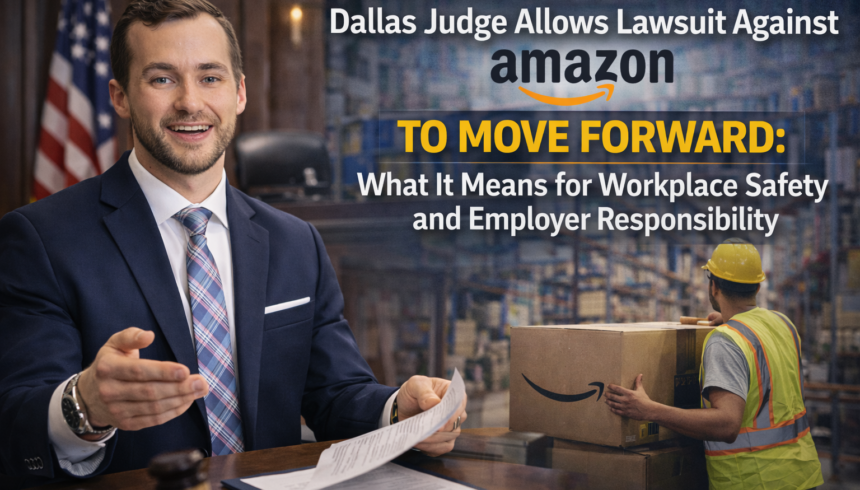
Dallas Judge Allows Lawsuit Against Amazon to Move Forward: What It Means for Workplace Safety and Employer Responsibility
April 2, 2026
  • Evan Lange By Evan Lange
  • No comment

Before proceeding, please review the  legal disclaimer.

Dallas Judge Allows Lawsuit Against Amazon to Move Forward: What It Means for Workplace Safety and Employer Responsibility

A recent court ruling in Dallas is drawing attention to an important issue in employment law: when can an employer be held responsible for the actions of a supervisor?

In a serious case involving allegations of kidnapping and sexual assault, a Texas judge has allowed a lawsuit against Amazon to proceed—rejecting the company’s attempt to have the case dismissed early.

While the facts alleged in the lawsuit are deeply troubling, the legal decision itself highlights key principles about workplace safety, employer liability, and employee protection.

Let’s break down what happened and why it matters.


What the Court Decided

A Dallas judge denied Amazon’s request to dismiss the lawsuit at an early stage. This means:

  • The case will move forward into discovery
  • Both sides will be able to gather evidence
  • Witnesses may be questioned under oath
  • Internal company practices may be examined

Additionally, the court ordered Amazon to pay attorney’s fees related to the motion to dismiss under Texas procedural law.

In simple terms:
👉 The court found that the case deserves to be fully examined—not dismissed upfront.


Why Amazon Tried to Dismiss the Case

Amazon argued that it should not be held legally responsible for the actions of the supervisor involved.

The company’s main arguments included:

  • The alleged conduct was not foreseeable
  • The actions were outside the scope of employment
  • The incident was not caused by company policies or training failures

These are common defenses in employer liability cases.


Why the Judge Rejected Those Arguments

The court allowed the case to proceed because the plaintiff’s allegations raised serious questions about what the company knew—and when.

According to the lawsuit:

  • There were prior complaints about the supervisor’s behavior
  • The employee was in a vulnerable position, participating in a workforce program for individuals with disabilities
  • The supervisor had authority over the employee
  • Company instructions may have required the employee to follow directions from supervisors without limitation

These allegations suggest that the employer may have had notice of potential risks.

👉 In legal terms, this relates to foreseeability—whether the employer could have anticipated the danger.


What Is “Foreseeability” in Employment Law?

Foreseeability is a key concept in determining employer liability.

An employer may be held responsible if:

  • It knew—or should have known—about risks
  • It failed to take reasonable steps to prevent harm
  • It allowed a dangerous situation to continue

If prior complaints or warning signs existed, courts may find that harm was foreseeable.


The Importance of Prior Complaints

One of the most significant aspects of this case involves allegations that:

  • Other employees had previously reported inappropriate behavior
  • The supervisor remained in a position of authority
  • Additional safeguards were not implemented

If proven, prior complaints can play a major role in establishing employer responsibility.

Employers are generally expected to:

  • Investigate complaints
  • Take corrective action
  • Protect employees from known risks

Workplace Safety and Vulnerable Employees

The case also raises important concerns about protecting vulnerable workers.

According to the allegations:

  • The employee was part of a program for individuals with disabilities
  • She was instructed to follow directions from supervisors
  • The supervisor allegedly used that authority to gain trust

Employers have a heightened responsibility to ensure safe working conditions, especially when employees may rely heavily on supervision.


What Happens Next: The Discovery Phase

Because the case was not dismissed, it now moves into discovery.

This phase allows both sides to:

  • Request internal company records
  • Review training materials and policies
  • Examine prior complaints
  • Take depositions (sworn testimony)

Discovery often reveals critical facts that determine how a case proceeds.


Why This Ruling Matters

This decision does not determine whether Amazon is liable—but it does send an important message:

👉 Courts will allow cases to proceed when there are credible allegations of employer negligence or failure to act.

The ruling reinforces that:

  • Employers may be held accountable for workplace safety
  • Prior complaints matter
  • Early dismissal is not guaranteed when serious allegations are involved

Broader Implications for Employers

Cases like this highlight the importance of:

  • Responding to employee complaints promptly
  • Conducting thorough investigations
  • Monitoring supervisors and workplace conduct
  • Implementing clear reporting systems
  • Protecting employees from potential harm

Failure to act on warning signs can expose companies to significant legal risk.


Final Takeaway

The Dallas court’s decision to allow this lawsuit to move forward underscores a key principle of employment law:

👉 Employers may be held responsible when they ignore warning signs or fail to protect employees from foreseeable harm.

While the case is still ongoing, it highlights the importance of workplace safety, accountability, and proper response to employee complaints.

As the discovery process unfolds, more details may emerge—but the ruling itself already emphasizes that serious workplace allegations deserve careful legal examination.


Leave a Reply

Your email address will not be published. Required fields are marked *

    Contact us for a consultation

    *Please do not include any confidential or sensitive information in this form. This form sends information by non-encrypted e-mail which is not se.Submitting this form does not create an attorney-client relationship. Once I have read your submission, I may contact you for more information or to arrange for a consultation with you.

    Mr. Evan B. Lange is the attorney responsible for this website. | All meetings are by appointment only. | Principal place of business: Sugar Land and Houston, Texas.
    The information you obtain at this site is not, nor is it intended to be, legal advice. You should consult an attorney for advice regarding your individual situation. We invite you to contact us and welcome you to submit your claim for review. Contacting us does not create an attorney-client relationship. Please do not send any confidential information to us until such time as an attorney-client relationship has been established.