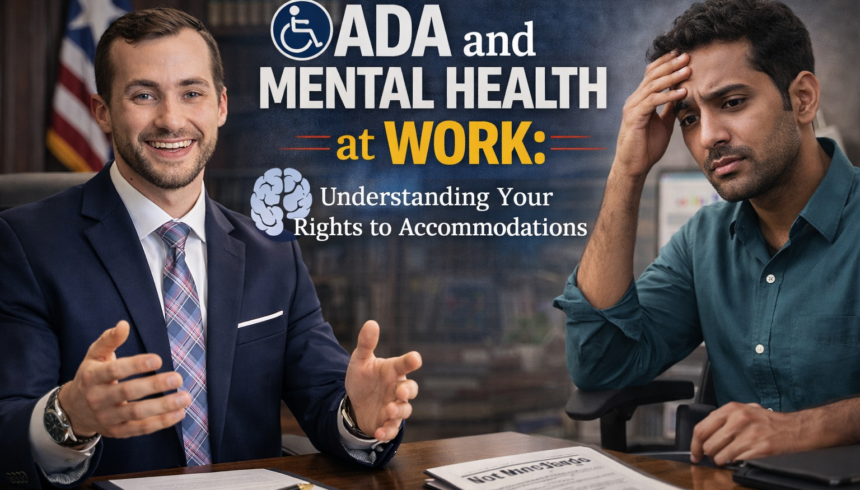
ADA and Mental Health at Work: Understanding Your Rights to Accommodations
March 26, 2026
  • Evan Lange By Evan Lange
  • No comment

Before proceeding, please review the  legal disclaimer.

ADA and Mental Health at Work: Understanding Your Rights to Accommodations

When people think about disability protections in the workplace, they often picture physical conditions—like mobility impairments or visible injuries.

But the law goes further than that.

The Americans with Disabilities Act (ADA) doesn’t just protect individuals with physical disabilities. It can also apply to mental health conditions, including anxiety, depression, PTSD, and other psychological conditions.

If a condition significantly affects your ability to function in daily life, you may have legal protections at work—including the right to request accommodations.

Understanding how this works is the first step toward protecting your rights.


Does the ADA Cover Mental Health Conditions?

Yes.

The ADA protects individuals with disabilities that substantially limit one or more major life activities. These activities can include:

  • Concentrating
  • Thinking
  • Communicating
  • Sleeping
  • Working
  • Interacting with others

Mental health conditions such as:

  • Anxiety disorders
  • Major depression
  • Post-traumatic stress disorder (PTSD)
  • Bipolar disorder
  • Obsessive-compulsive disorder (OCD)

may qualify as disabilities under the ADA if they significantly impact daily functioning.


What Does “Substantially Limits” Mean?

A condition does not have to be permanent or severe in every moment to qualify.

A mental health condition may be protected if it:

  • Interferes with your ability to focus or complete tasks
  • Impacts your sleep or energy levels
  • Affects communication or social interaction
  • Makes it difficult to perform job duties consistently

The focus is on how the condition affects your ability to function, not just the diagnosis itself.


What Are Reasonable Accommodations?

If you qualify under the ADA, you may be entitled to reasonable accommodations—adjustments that help you perform your job effectively.

For mental health conditions, accommodations may include:

  • Flexible work schedules
  • Modified break times
  • Remote or hybrid work options
  • Quiet or low-distraction workspaces
  • Adjusted deadlines or workload expectations
  • Changes in communication methods
  • Time off for treatment or therapy

These accommodations are designed to remove barriers—not to give special treatment.


The Interactive Process

Once an employee requests an accommodation, the employer is generally required to engage in an interactive process.

This means:

  • Discussing the employee’s needs
  • Evaluating possible accommodations
  • Considering alternatives if needed

Employers do not have to provide the exact accommodation requested, but they must seriously consider reasonable options.

Ignoring or dismissing a request without discussion may raise legal concerns.


Can an Employer Deny an Accommodation?

Yes—but only in certain situations.

An employer may deny an accommodation if:

  • It creates undue hardship (significant difficulty or expense)
  • The employee cannot perform essential job duties even with accommodation
  • The request is not reasonable under the circumstances

However, employers must be able to explain their reasoning.


Confidentiality and Disclosure

Employees are not required to disclose every detail about their mental health.

However, to request an accommodation, you may need to:

  • Inform your employer that you have a medical condition
  • Provide limited documentation if requested

Employers must keep this information confidential.


Common Workplace Challenges

Mental health-related ADA issues often arise when:

  • Employers misunderstand invisible disabilities
  • Requests for flexibility are dismissed
  • Employees are disciplined for symptoms of their condition
  • Communication breakdowns occur between management and employees

These situations can sometimes lead to disputes about whether accommodations were properly handled.


What Employees Should Do

If you believe your mental health condition is affecting your work, consider:

  • Communicating your needs clearly
  • Requesting accommodations in writing
  • Keeping records of conversations
  • Saving documentation related to your condition

Taking proactive steps can help create clarity and protect your position.


Final Takeaway

The ADA is not limited to physical disabilities—it also protects employees with qualifying mental health conditions like anxiety, depression, and PTSD.

If a condition substantially limits your ability to function, you may have the right to reasonable accommodations at work.

Understanding your rights is the first step toward ensuring that your workplace is not only compliant with the law—but also supportive of your ability to succeed.


Leave a Reply

Your email address will not be published. Required fields are marked *

    Contact us for a consultation

    *Please do not include any confidential or sensitive information in this form. This form sends information by non-encrypted e-mail which is not se.Submitting this form does not create an attorney-client relationship. Once I have read your submission, I may contact you for more information or to arrange for a consultation with you.

    Mr. Evan B. Lange is the attorney responsible for this website. | All meetings are by appointment only. | Principal place of business: Sugar Land and Houston, Texas.
    The information you obtain at this site is not, nor is it intended to be, legal advice. You should consult an attorney for advice regarding your individual situation. We invite you to contact us and welcome you to submit your claim for review. Contacting us does not create an attorney-client relationship. Please do not send any confidential information to us until such time as an attorney-client relationship has been established.